English
 Arabic
 French
 Spanish
 Portuguese
 Deutsch
 Turkish
 Dutch
Dutch
 Italiano
 Russian
 Romaian
 Portuguese (Brazil)
 Greek
Greek

The Rise of the Spider Hoodie: Why the Sp5der Hoodie Is Dominating
Other |
2026-02-09 06:24:49

Watching a skilled Suphini artisan at work, you might assume they were born with a lasting hammer in one hand and a stitching awl in the other. The truth is more inspiring: nearly all of our craftspeople came to us with no prior shoemaking experience. They were dancers, leatherworkers, sewing enthusiasts, or simply people looking for meaningful work. What transformed them into artisans capable of producing consistent, high-quality dance shoes was a deliberate, patient training process that Suphini has refined over many years. Consistency in handmade dance shoes goods does not happen by accident. It happens through structured learning, repeated practice, and a workshop culture that values precision over speed. Here is an inside look at how we build our team.
New trainees spend their first two weeks touching leather, and only leather. No cutting, no stitching, no lasting. Suphini believes you cannot make a good shoe until you understand what you are working with. Trainees learn to identify different grades of leather by sight and touch: full-grain versus top-grain, calf versus goat, oiled suede versus nubuck. They learn how each hide responds to tension, moisture, and heat. They practice spotting natural imperfections like scars or stretch marks that make a hide unsuitable for certain shoe parts. They also study the vegetable-tanning process and why it produces different handling characteristics than chrome tanning. By the end of material literacy training, a new artisan can pick up a random piece of leather, close their eyes, and tell you its approximate thickness, tannage, and recommended use. This foundational knowledge prevents countless mistakes later in the production process.
Cutting leather is deceptively difficult. Press too hard with the knife and you cut into your work surface or, worse, your finger. Press too lightly and you leave ragged edges that ruin the fit. Suphini trains cutters using a progressive method. First, trainees practice on scrap leather, following simple geometric shapes traced onto the hide. They must complete one hundred perfect circles before moving to squares, then another hundred perfect squares before moving to actual shoe pattern pieces. Instructors check every cut with a magnifying loupe, rejecting any piece with a wavy edge or nick. Once basic cutting is mastered, trainees learn pattern nesting: arranging shoe pieces on a hide to minimize waste. This spatial reasoning skill takes months to develop. Skilled cutters eventually achieve waste rates below fifteen percent, far better than the industry average of thirty percent. They also learn to cut around natural hide imperfections, shifting patterns to avoid weak spots without creating excess scrap.
Stitching machines look simple, but they hide endless complexity. A stitch that is too tight puckers the leather and creates pressure points inside the shoe. A stitch that is too loose unravels under the stress of dancing. Suphini trainees spend weeks sewing nothing but straight lines on practice leather, adjusting tension settings and thread types until they can produce a seam that lies perfectly flat. Instructors have them close their eyes and feel the seam with their fingertips, training them to recognize correct tension by touch alone. Seam allowance is another critical skill. Different parts of a dance shoe require different margins: a narrow three-millimeter allowance for the toe, a generous eight-millimeter allowance for the heel cup where stress is highest. Trainees practice measuring allowances without looking at a ruler, using only their thumb width or a folded finger as a guide. By the end of stitching training, an artisan can produce fifty identical seams in a row, each one the exact same length, tension, and allowance.
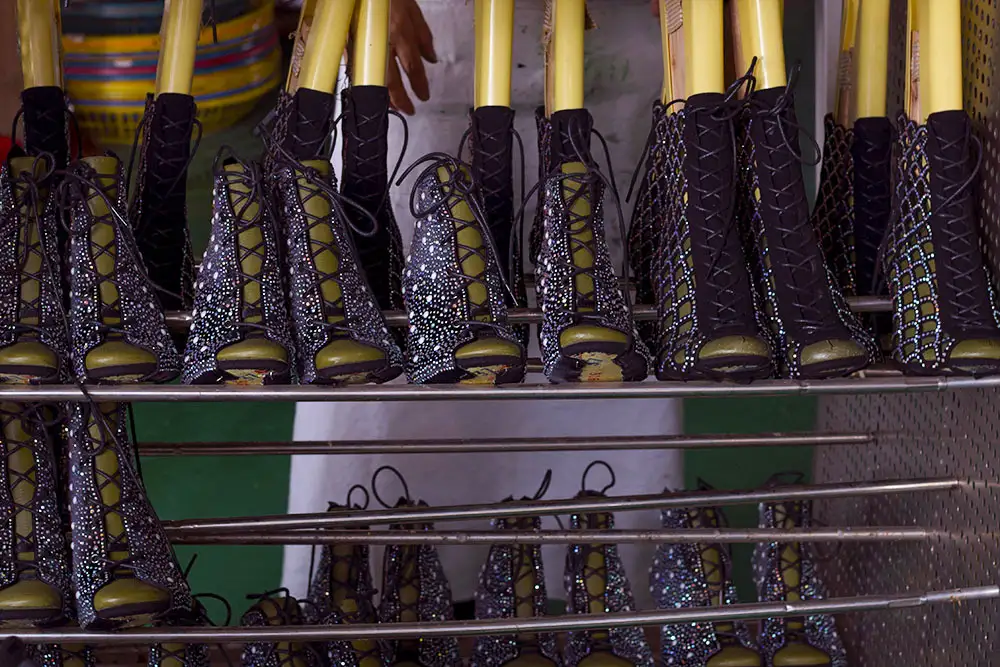
Lasting is the heart of shoemaking, and it is where most trainees feel the most anxiety. Pulling the leather upper over a wooden last requires exactly the right amount of tension: too loose and the shoe wrinkles, too tight and the leather tears or the seam pops. Suphini built a set of practice lasts shaped like oversized cartoon feet, with exaggerated contours that make mistakes obvious. Trainees practice lasting on these mock feet for at least forty hours before touching a real last. They learn the sequence of tacking: center the toe, pull the heel, then work around the perimeter in a specific order that distributes tension evenly. Instructors watch for common errors like over-pulling the instep or leaving puckers at the toe box. Only when a trainee can consistently produce a smooth, wrinkle-free upper on a practice last do they graduate to customer shoes. Even then, their first fifty lasting jobs are inspected by a master artisan before the sole is attached.
A beautiful upper means nothing if the sole falls off after three rehearsals. Suphini trains sole attachment as a separate specialty, though many artisans eventually learn multiple stations. Trainees first practice applying water-based adhesive to practice soles, learning to spread an even layer that covers the entire surface without pooling at the edges. They learn the critical timing of adhesive curing: too soon and the bond is weak, too late and the glue has dried beyond usability. For stitched soles, trainees learn to operate a heavy-duty sole stitcher, a machine that resembles a miniature industrial press. Heel building is its own art form. Trainees stack layers of leather, gluing and nailing each layer before shaping the final heel on a sanding wheel. They learn to match heel heights exactly to customer specifications, with a tolerance of less than one millimeter. A poorly built heel can throw off a dancer’s alignment, so this training is treated with particular seriousness.
Training never truly ends at Suphini. Every artisan, from first-year apprentices to twenty-year veterans, participates in weekly quality audits. A rotating team of three craftspeople inspects a random sample of shoes from each production station, looking for deviations from the standard. Found a loose thread? That is a note for the stitcher. Noticed a slightly uneven heel stack? The heel builder hears about it. These audits are not punitive. They are framed as learning opportunities, with the goal of catching small issues before they become habits. Suphini also encourages peer review, where artisans trade shoes and offer constructive feedback. This culture of mutual accountability produces remarkable consistency. A pair of Suphini shoes made by our newest trainee should be indistinguishable from a pair made by our most experienced master, at least to the naked eye. That consistency is what studios and professionals rely on, and it is built one training hour at a time.