English
 Arabic
 French
 Spanish
 Portuguese
 Deutsch
 Turkish
 Dutch
Dutch
 Italiano
 Russian
 Romaian
 Portuguese (Brazil)
 Greek
Greek

Shri Gajanan Maharaj Sansthan, Shegaon
Other |
2026-04-29 09:22:26
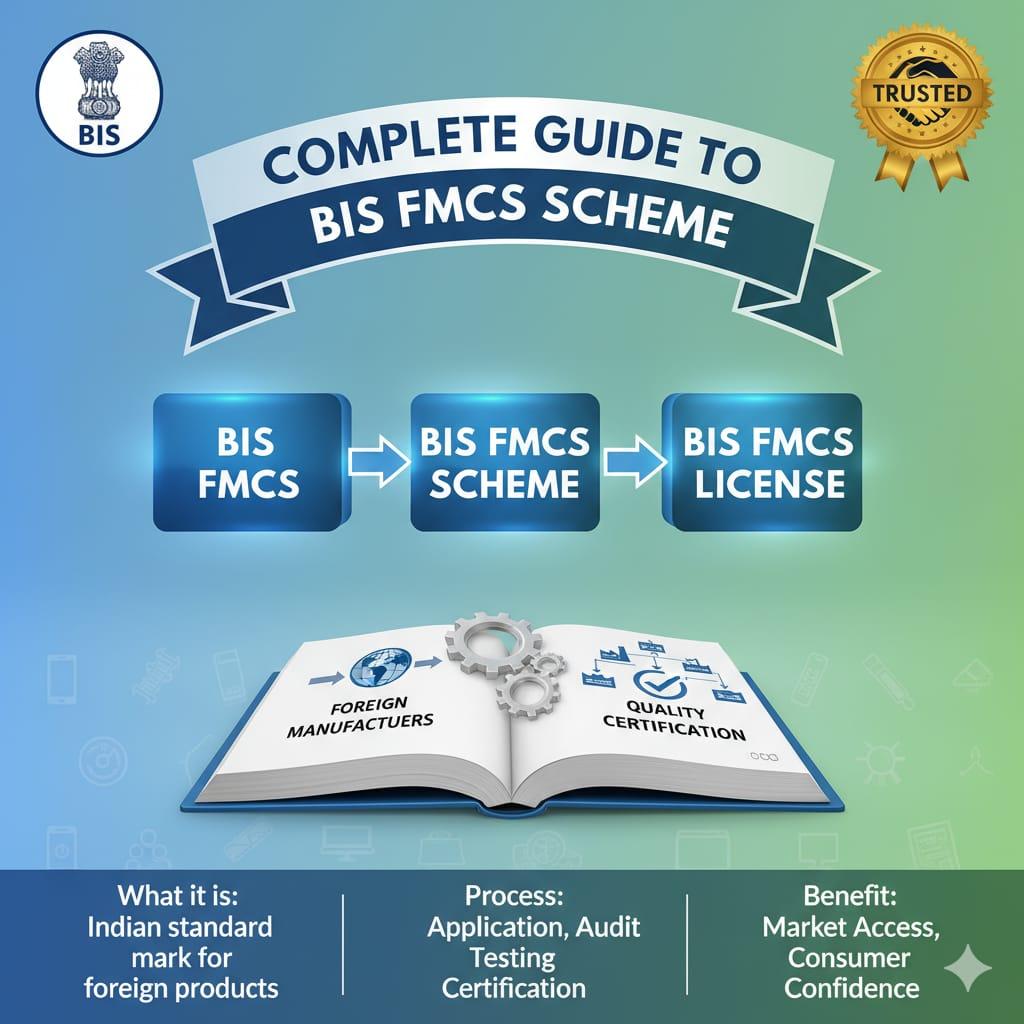
Expanding business in the Indian market is a major opportunity for foreign manufacturers. However, many products cannot be sold in India without meeting Indian quality and safety standards. This is where BIS FMCS becomes important. The Bureau of Indian Standards (BIS) introduced the Foreign Manufacturers Certification Scheme (FMCS) to ensure that imported products meet Indian safety and quality requirements.
If you are a foreign manufacturer planning to export products to India, understanding the BIS FMCS process is essential. From documentation to factory inspection and license approval, every step must be completed correctly to avoid delays.
In this blog, we will explain everything about BIS FMCS Certification, eligibility, process, benefits, documents, cost, and how a professional BIS FMCS consultant can help foreign companies obtain approval quickly.
BIS FMCS stands for Foreign Manufacturers Certification Scheme. It is a certification system managed by the Bureau of Indian Standards that allows foreign manufacturers to use the ISI Mark on their products.
Under this scheme, overseas manufacturers can obtain a BIS license for products that fall under mandatory Indian standards. Once approved, the manufacturer can sell products in India legally with the BIS standard mark.
The scheme ensures that imported products provide the same quality and safety standards as products manufactured in India.
BIS FMCS Certification is the official approval granted to foreign manufacturers after successful inspection, product testing, and compliance verification.
The certification confirms that the product complies with the applicable Indian Standard (IS). It also allows the manufacturer to use the ISI mark on certified products.
Foreign manufacturers from countries such as China, the USA, Germany, Japan, South Korea, Italy, and many others apply for BIS FMCS certification before exporting regulated products to India.
Obtaining BIS certification for foreign manufacturers is important for several reasons:
Many products cannot be imported into India without BIS approval.
Certification helps foreign companies enter the Indian market smoothly.
Products with the ISI mark are trusted by Indian buyers.
BIS ensures that products meet Indian quality and safety standards.
Without certification, customs authorities may stop product clearance.
Many products require BIS FMCS approval before import into India. Some common product categories include:
Electrical appliances
Steel products
Cement products
Household goods
Automotive components
Chemicals
Industrial equipment
Pressure cookers
Batteries
Toys and safety products
Each product category follows a specific Indian Standard (IS code).
A foreign manufacturer can apply for a BIS FMCS license if:
The manufacturing unit is located outside India
The product falls under mandatory BIS certification
The factory has proper testing facilities
The manufacturer appoints an Authorized Indian Representative (AIR)
The product complies with applicable Indian Standards
The Authorized Indian Representative acts as a communication link between BIS and the foreign manufacturer.
Understanding the application process is important for faster approval. Below is the complete process for BIS FMCS certification.
The first step is to determine whether your product requires mandatory BIS certification and identify the relevant Indian Standard.
Foreign manufacturers must appoint an AIR in India who will coordinate with BIS authorities.
The applicant must prepare all required documents, including:
Factory registration certificate
Product details
Manufacturing process information
Test reports
Quality control documents
Authorized Indian Representative documents
The BIS FMCS application is submitted along with prescribed fees and supporting documents.
BIS officers visit the manufacturing unit located outside India. During inspection, they verify:
Manufacturing process
Quality control systems
In-house testing facilities
Product compliance
Samples are collected and tested in BIS-approved laboratories.
After successful inspection and testing, BIS grants the certification license.
The following documents are generally required:
Business license of manufacturer
Factory address proof
Product specifications
Manufacturing process flow chart
List of testing equipment
Calibration certificates
Quality management system documents
Trademark authorization letter
AIR nomination documents
Previous test reports
Document accuracy is extremely important because incorrect information can delay approval.
The BIS certification process can be complex for foreign manufacturers because it involves technical standards, factory audits, and compliance requirements.
A professional BIS FMCS consultant can help manufacturers by:
Identifying applicable standards
Preparing documentation
Coordinating with BIS authorities
Managing factory inspection support
Assisting with testing procedures
Reducing approval delays
Helping with renewal and compliance
Experienced consultants understand BIS regulations and simplify the entire certification process.
The BIS FMCS license is generally granted for one year initially. After that, manufacturers can renew the license based on compliance and production continuity.
Renewal requires:
Compliance with BIS standards
Timely submission of renewal documents
Payment of applicable fees
Continued product quality maintenance
The total cost of BIS FMCS Certification depends on several factors such as:
Product category
Number of products
Factory location
Testing charges
Inspection expenses
Application fees
Consultant charges
Foreign manufacturers should plan certification budgets carefully because BIS inspections involve international factory visits.
Foreign manufacturers often face challenges such as:
Missing or incorrect documents may delay approval.
Products may fail testing if they do not meet Indian standards.
Coordination between BIS, laboratories, and manufacturers can take time.
Factories must maintain proper quality control systems.
Indian Standards are updated regularly, requiring technical compliance.
Professional consultants can help avoid these common mistakes.
There are many benefits of obtaining a BIS FMCS license.
Certified products can be imported and sold legally in India.
The ISI mark increases customer trust and confidence.
Certified products gain an advantage over non-certified competitors.
BIS compliance improves manufacturing quality standards.
Certification helps avoid penalties, shipment rejection, and customs issues.
Many foreign manufacturers confuse CRS and FMCS certification.
|
Feature |
BIS FMCS |
BIS CRS |
|
Certification Type |
ISI Mark Scheme |
Registration Scheme |
|
Applicable Products |
Industrial and safety products |
Electronics and IT products |
|
Factory Inspection |
Mandatory |
Usually not mandatory |
|
License Type |
BIS License |
BIS Registration |
|
Product Marking |
ISI Mark |
Standard Registration Number |
Choosing the correct certification scheme is important for compliance.
Here are some useful tips for foreign manufacturers:
Verify product standards before applying
Maintain proper testing facilities
Prepare accurate documentation
Conduct internal quality audits
Work with an experienced BIS FMCS consultant
Ensure product samples meet Indian Standards
Respond quickly to BIS queries
These steps can significantly reduce approval delays.
India continues to strengthen quality control regulations for imported goods. More product categories are being added under mandatory certification requirements.
As a result, bis certification for foreign manufacturers is becoming increasingly important for global businesses entering India.
Manufacturers who obtain certification early can build strong market credibility and avoid regulatory issues in the future.
The BIS FMCS scheme is an essential requirement for foreign manufacturers who want to export products to India legally. From factory inspection to product testing and licensing, every step plays an important role in ensuring product quality and compliance.
Obtaining BIS FMCS Certification not only helps companies meet Indian regulations but also improves brand trust, market access, and customer confidence.
Since the certification process can be technical and time-consuming, working with an experienced BIS FMCS consultant can simplify the process and help manufacturers receive approvals faster.
If your company is planning to apply for a BIS FMCS license, professional guidance can help you avoid delays and ensure smooth certification.