English
 Arabic
 French
 Spanish
 Portuguese
 Deutsch
 Turkish
 Dutch
Dutch
 Italiano
 Russian
 Romaian
 Portuguese (Brazil)
 Greek
Greek

Chemical Protective Clothing Market – Industry Analysis, Trends, and Growth Outlook
Other |
2025-10-30 09:41:18
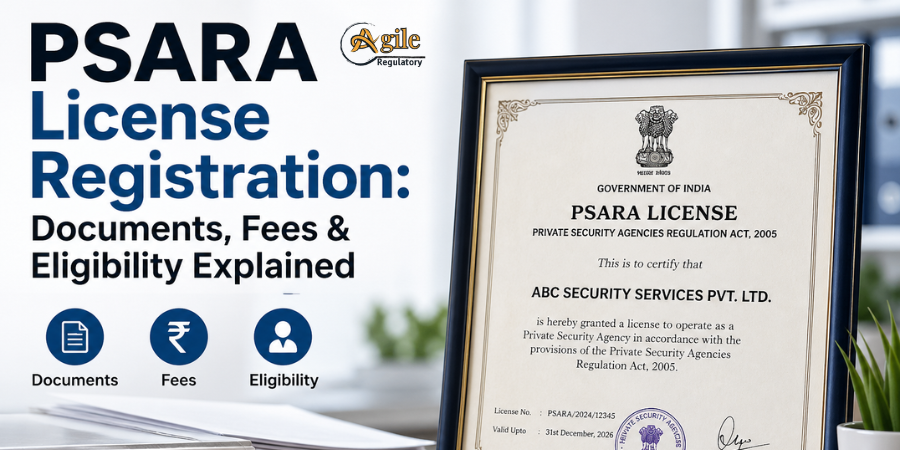
Starting a private security agency in India requires proper legal authorization, and the most important requirement is obtaining a PSARA License. Without this license, operating a security agency is not permitted under Indian law.
In this blog, we will explain the PSARA License registration process, along with detailed insights on documents, fees, and eligibility criteria to help you get started smoothly.
PSARA License registration is the process of obtaining approval from the government to operate a private security agency. It is regulated under the Private Security Agencies Regulation Act, 2005, which ensures that all agencies follow standard procedures for hiring and training security personnel.
The registration ensures transparency, accountability, and professionalism in the private security sector.
Registering under PSARA is not just a legal formality—it plays a crucial role in building a successful security business.
Legal authorization to run a security agency
Improved brand credibility
Access to corporate and government contracts
Structured employee training system
Increased client trust
Before applying for registration, you must ensure that you meet the eligibility conditions:
Only Indian citizens are eligible to apply for a PSARA License.
Applicants must not have any criminal record.
You must have a registered entity such as:
Sole Proprietorship
Partnership Firm
LLP
Private Limited Company
The applicant should have sufficient financial resources to manage operations.
You must have a tie-up with a government-approved training institute.
Documentation is one of the most critical aspects of PSARA registration. Missing or incorrect documents can lead to delays or rejection.
PAN Card of applicant
Aadhaar Card or Identity proof
Passport-size photographs
Certificate of incorporation/registration
GST registration certificate
MOA & AOA (for companies)
Address proof of registered office
Rent agreement or ownership proof
Affidavit as per PSARA rules
Police verification certificate
Employee details
Training institute agreement (MOU)
The PSARA registration process involves several steps. Here’s a complete breakdown:
First, you need to establish a legal business entity. This is mandatory before applying for the license.
Set up a proper office with valid address proof in the state where you plan to operate.
Submit details for police verification of:
Applicant
Directors/Partners
This ensures there is no criminal background.
Sign an agreement with a certified training institute to provide training to your security guards.
Submit the PSARA application to the state controlling authority along with all documents and fees.
Authorities will:
Verify documents
Conduct office inspection (if required)
After successful verification, the PSARA License is granted.
The government fee depends on the area of operation:
Single District: ₹5,000
Up to Five Districts: ₹10,000
Entire State: ₹25,000
Professional fees
Documentation charges
Training expenses
The validity of the license varies by state but generally falls between:
1 to 5 years
You must apply for renewal before expiry to continue operations.
To renew your license, you need to:
Submit renewal application
Provide updated documents
Pay renewal fees
Undergo verification
Timely renewal is essential to avoid penalties.
After obtaining the PSARA License, agencies must follow certain rules:
Maintain employee records
Ensure proper uniforms for guards
Conduct regular training
Follow labor laws
Submit periodic reports
Failure to comply can lead to suspension or cancellation of the license.
Many applicants face difficulties during registration, such as:
Complex documentation process
Delays in police verification
Lack of clarity on state-specific rules
Difficulty in finding approved training institutes
These challenges can slow down the approval process.
To avoid delays and complications, follow these tips:
Prepare all documents in advance
Ensure accuracy in application
Choose the correct business structure
Partner with a reliable training institute
Seek professional assistance
If you are planning to register for a PSARA License, Agile Regulatory can make the process simple and efficient.
Our services include:
Complete documentation support
Application filing
Expert consultation
Coordination with authorities
We help you avoid delays and ensure faster approval.
PSARA License registration is a crucial step for starting a private security agency in India. It ensures that your business operates legally and follows government regulations.
By understanding the eligibility criteria, required documents, and registration process, you can successfully obtain your license without unnecessary delays.
For a hassle-free experience, professional guidance from Agile Regulatory can help you navigate the complexities and get your PSARA License quickly.