English
 Arabic
 French
 Spanish
 Portuguese
 Deutsch
 Turkish
 Dutch
Dutch
 Italiano
 Russian
 Romaian
 Portuguese (Brazil)
 Greek
Greek

Dengue Treatment Market Graph: Growth, Share, Value, Insights, and Trends
Other |
2025-12-17 05:17:52
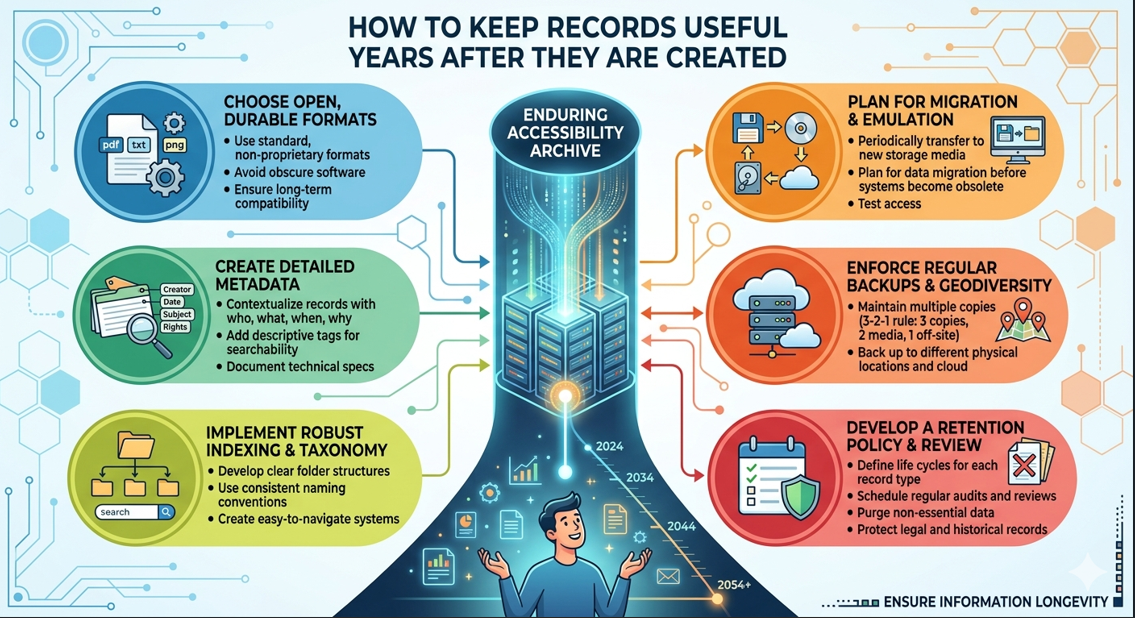
Long-Term Archiving is the practice of keeping records useful, readable, secure, and easy to retrieve years after they were created. For businesses, this matters because old documents often carry future value. A contract may become important during a dispute. A tax file may be needed during an audit. Employee records may support compliance. Project files may explain why a decision was made years earlier.
The problem is that many organizations treat archiving like simple storage. They save files in folders, drives, inboxes, or cloud platforms and assume the job is done. Then, years later, someone needs one specific record and the search turns into a scavenger hunt. The file exists somewhere, but no one knows where. Or the file opens, but the version is unclear. Or the document is stored safely, but it cannot be searched.
That is where proper archiving earns its value. It keeps records alive as business evidence, operational memory, and compliance support. In a world where data breaches, system migrations, remote work, and digital overload are normal business risks, keeping records useful over time requires structure from the start.
Records usually lose value because they lose context. The file may still exist, but the information around it disappears. Who created it? Who approved it? Which department owned it? Was it the final version? How long should it be kept? Can it still be trusted?
These questions become harder when businesses rely on loose storage habits. Files get saved with weak names like “scan001.pdf” or “contract_final_final_v2.” Employees create their own folder systems. Documents are shared through email. Old records sit inside platforms that no one actively manages. Eventually, the organization has storage, but very little control.
There is also a technical side. Digital records depend on software, formats, access rights, and systems. A file created today may need to remain readable ten years from now. If the business changes platforms, loses metadata, or depends on outdated file formats, the record may become difficult to use even if it still exists.
This is why archiving must focus on future usability. A record should be stored with enough information to make sense later. It needs a clear name, proper metadata, ownership, access rules, retention dates, and version control. Without those basics, old records become digital clutter.
Many businesses confuse storage with archiving. Storage keeps files somewhere. Archiving keeps records usable for a defined purpose.
A shared drive may store thousands of documents, but that does not mean it functions as an archive. A real archive provides structure. It separates active files from long-term records. It applies retention rules. It controls access. It supports search. It preserves the record in a format that can remain usable over time.
The ISO 14721:2025 standard, also known as the Open Archival Information System reference model, provides a framework for long-term digital information preservation and access. It also explains concepts that help non-archival organizations participate effectively in digital preservation. That matters because archiving is no longer only a concern for libraries, government agencies, or museums. Businesses now rely on long-term digital evidence every day.
A good archive answers practical business questions fast. For example:
If a business cannot answer those questions, its archive needs work.
Strong Long-Term Archiving starts when a record is created, received, or captured. Waiting until documents pile up creates more cleanup work later. The smarter approach is to classify records early.
Every important record should enter the system with basic details attached. That includes the document type, date, department, owner, client or vendor name, retention category, access level, and status. These details may sound small, but they decide whether a record remains useful later.
Retention planning is especially important. The U.S. National Archives explains that records management guidance covers the creation, management, and disposition of records, with emphasis on electronic records. In practical terms, records need rules for how they are created, kept, reviewed, transferred, or deleted.
Without retention rules, businesses tend to make two bad choices. They either keep everything forever, which increases cost and risk, or they delete files too casually, which can create legal and operational problems. A strong lifecycle avoids both extremes. It keeps the right records for the right length of time.
Search is where archives often succeed or fail. If employees cannot find the right file without asking multiple people, the archive is weak.
Metadata solves that problem. It gives documents structure beyond the file name. A vendor agreement, for example, should include the vendor name, agreement date, renewal date, department, document type, and approval status. A finance record should include the period, account, entity, document type, and retention category. A legal document should include matter name, date, version, owner, and confidentiality level.
This turns search from guesswork into retrieval. A user can search by year, client, department, record type, or status. That is much better than digging through folders with vague names.
Scanned documents need extra care. Optical character recognition can make scanned text searchable, but OCR alone does not create a reliable archive. A scanned invoice may become searchable, but the system still needs to know invoice number, supplier, amount, date, and approval status.
Useful archiving needs both readable content and structured data. One helps the system search the document. The other helps the business understand what the document means.
Old records can still create new risks. Contracts, financial files, HR records, customer documents, legal files, board materials, and intellectual property may remain sensitive for years. Archiving them without access control is a weak move.
IBM’s 2025 Cost of a Data Breach Report placed the global average cost of a data breach at USD 4.4 million. That figure makes one thing clear: stored information still needs protection, even when it is no longer active in daily workflows.
A proper archive should include role-based access, encryption, multi-factor authentication, audit logs, backup protection, and clear deletion or disposition workflows. Employees should only access the records they need. Sensitive documents should not sit in open folders. When someone views, changes, exports, or deletes a record, the system should record that activity.
Third-party access also needs attention. Verizon’s 2025 Data Breach Investigations Report found that third-party involvement in breaches doubled to 30%, while vulnerability exploitation increased by 34%. That matters for archived records because businesses often share documents with vendors, consultants, auditors, legal teams, and external platforms.
Security must follow the record throughout its lifecycle. The fact that a document is old does not make it harmless.
Every business changes systems eventually. A document platform gets replaced. A cloud provider changes terms. A department moves to a new tool. A merger brings new data requirements. A vendor shuts down a product. These changes can damage archives if records are trapped inside one system with poor export options.
A strong archive should be portable. That means records and metadata should be exportable in usable formats. The archive should rely on widely accepted file formats where possible. It should have documented structures, naming rules, and access policies. It should also be tested.
Testing is simple, but many companies skip it. Pick older records and try to retrieve them. Open them. Confirm the metadata. Check the permissions. Review the audit history. Make sure the records still work outside the original team that created them.
This is where archiving becomes a business continuity issue. During an audit, lawsuit, acquisition, insurance claim, or compliance review, nobody wants to discover that key files are missing, unreadable, or impossible to verify.
Compliance is one of the strongest reasons to take Long-Term Archiving seriously. Many industries must retain records for defined periods. Some records need to remain authentic, complete, and accessible. Others must be deleted after their retention period ends.
The risk comes from poor control. Keeping too little can create compliance gaps. Keeping too much can increase exposure. Keeping records without proof of authenticity can weaken the organization’s position during disputes or audits.
A strong archive supports trust because it preserves more than the file. It preserves the story around the file: when it was created, who handled it, what version was approved, where it was stored, and how it was protected.
That matters for regulated businesses, but it also matters for ordinary companies. Every organization needs proof at some point. Proof of payment. Proof of approval. Proof of delivery. Proof of agreement. Proof of compliance. An archive turns old documents into usable evidence.
Businesses do not need to fix every record at once. Start with high-value and high-risk documents. Contracts, legal records, finance files, HR documents, board records, compliance evidence, project files, and customer records should come first.
Then create a practical archiving framework. Define record categories. Set retention rules. Standardize naming. Add required metadata. Limit access by role. Choose durable file formats. Keep audit logs. Review records on a schedule. Test retrieval regularly.
The process should be simple enough for teams to follow. A complicated archive policy that nobody uses is just another document gathering dust. Good systems make the right behavior easy.
The goal is not to keep every file forever. The goal is to keep valuable records in a condition where they can still serve the business years later.
Long-Term Archiving protects the future usefulness of business records. It keeps documents searchable, readable, secure, and trustworthy long after their original purpose has passed. That matters because old records often become important again during audits, disputes, compliance checks, system migrations and major business decisions.
Businesses that treat archiving as simple storage will keep creating digital clutter. Businesses that build structure around their records will save time, reduce risk, and protect institutional memory.
The best archive does not create drama. It works quietly. Records are easy to find. Permissions are controlled. Retention rules are clear. Old documents still open. Audit trails are available. When proof is needed, the organization can produce it without panic.