Introduction
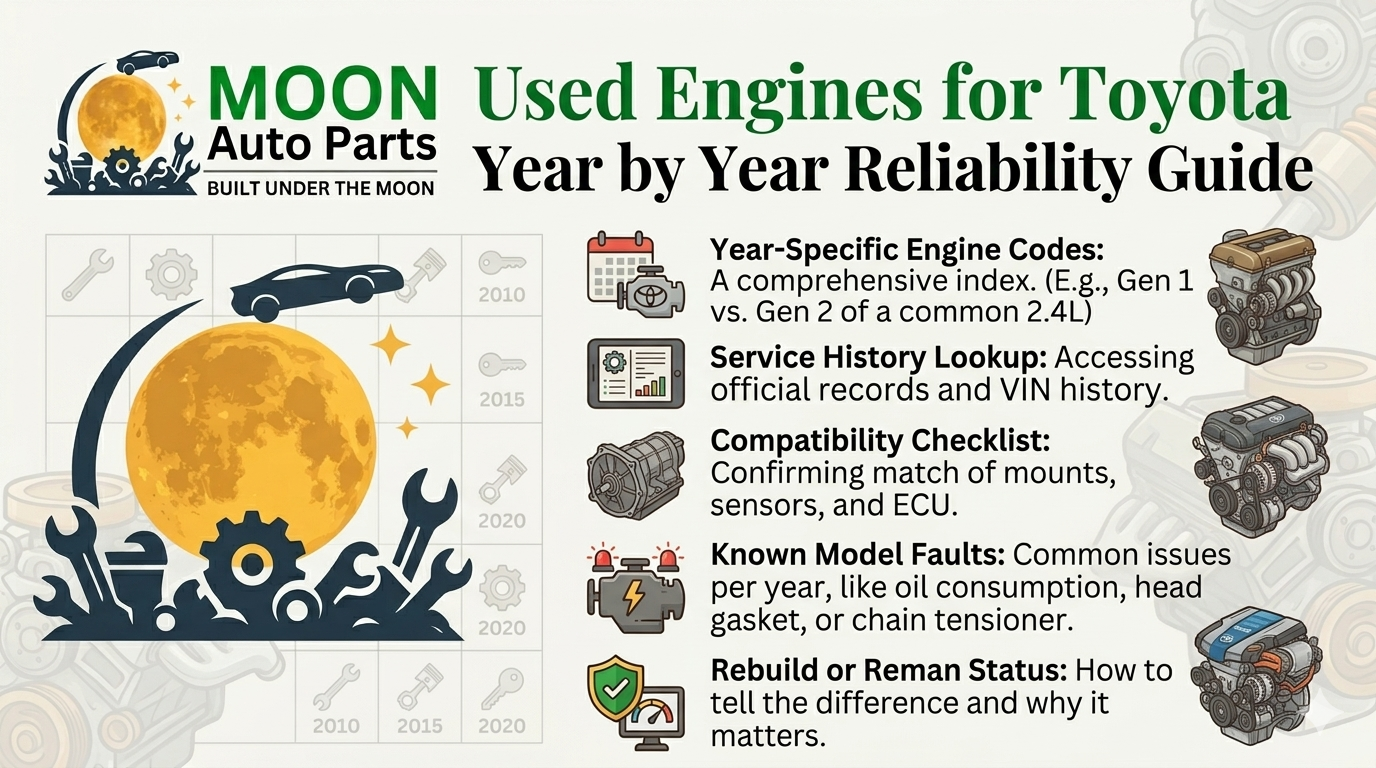
When searching for used engines for Toyota vehicles, the number of available options can feel reassuring until you realize how many variables affect whether a particular engine is actually suitable for your application. Toyota has produced dozens of distinct engine families across more than six decades of manufacturing, and the used market reflects that complexity. This guide serves as a reference resource organized around real problems, year-specific data, and compatibility details to help Toyota owners and mechanics make genuinely informed decisions when evaluating used engine options.
Problems Specific to the Used Toyota Engine Market
- Platform Confusion: Toyota often used the same engine code across completely different platforms (FWD vs. RWD, for example). An engine that physically fits may have the wrong accessory layout or mount configuration for your vehicle.
- Timing Belt Neglect: Many Toyota engines particularly pre-2008 four-cylinders and V6s use timing belts with specific replacement intervals. A Used Engines for Toyota near or past its belt interval is a ticking clock. Failure is catastrophic.
- 1MZ-FE Sludge Epidemic: The 3.0L 1MZ-FE V6 in Camry, Sienna, and Lexus ES300 models produced between 1997–2002 is notorious for oil sludge formation when oil changes were deferred. Inspect any used unit from this family with a borescope if possible.
- Head Gasket History on 2AZ-FE: Early 2AZ-FE engines (2002–2006 in some applications) had documented head gasket issues. Toyota issued a warranty extension on affected units. Verify the production code before buying.
- Hydrolock Risk from Flood Vehicles: Toyota vehicles were heavily represented in flood-damaged inventories following major US storms. Engines from flooded vehicles look externally clean after reconditioning but carry hidden internal damage.
Key Points
- Identify whether your Toyota application requires a timing belt or chain engine — these require very different post-purchase maintenance plans.
- Cross-reference the donor engine's casting date code against the known revision timeline for known problem engines (especially 2AZ-FE and 1MZ-FE).
- Confirm VVT-i oil control valve responsiveness if testing is possible a sticky VVT-i valve causes rough idle and performance loss.
- Check the condition of the harmonic balancer cracked or delaminated rubber layers indicate an engine that experienced irregular loads or overheating.
- Verify that the engine's accessory ports (power steering, AC compressor bracket, alternator mount) match your vehicle's configuration before shipment or purchase.
Compatibility
Toyota used engines span a wide range of applications, and matching the right engine requires attention to several variables:
- Displacement and Code Match: A 2.4L 2AZ-FE from a RAV4 and a 2.4L 2AZ-FE from a Camry carry the same base code but may have different oil pan configurations and accessory drives.
- FWD vs. RWD/AWD Configuration: The 2GR-FE used in FWD Camry applications differs from the version used in RWD-based vehicles in terms of oil pan design and motor mount locations.
- Hybrid Powertrain Engines: Toyota's Hybrid Synergy Drive engines (in Prius and Camry Hybrid) are not compatible with standard gasoline drivetrain applications. These are a separate category entirely.
- Emission System Integration: Later Tier 3 emission-compliant engines differ from earlier Tier 2 units in their sensor configuration and exhaust port design.
Year-Related Considerations
- 1990–1997: 3S-FE, 5S-FE, 7A-FE — these engines are now 27–35 years old. Parts availability is decreasing. Suitable only if you can thoroughly inspect the internals.
- 1997–2002: 1MZ-FE V6 sludge risk window. Any engine from this period requires confirmed oil service history. Post-2002 units are safer.
- 2002–2009: 2AZ-FE four-cylinder verify production code. Post-2006 units with revised head gasket design are preferable.
- 2009–2015: The 2GR-FE V6 and 1GR-FE 4.0L represent the most reliable and well-documented window for used Toyota engines currently available.
- 2016–Present: Direct injection and port/direct combined injection engines. More complex electronics, ECU coding often required, but mechanically strong with no major known issues.
Conclusion
Used engines for Toyota vehicles are among the most available and thoroughly documented in the entire used powertrain market. That advantage only translates to a good purchase when buyers use the information available to them — checking codes, understanding known problem windows, verifying timing component status, and confirming source vehicle history. The data exists. Using it is the difference between a reliable repair and an expensive lesson.
FAQ
Q: Which used Toyota engine has the best reputation for longevity?
The 2GR-FE 3.5L V6 and the 1GR-FE 4.0L V6 consistently receive the highest long-term reliability marks from mechanics and owners alike.
Q: How do I tell if a used Toyota engine has a timing belt or chain?
Consult Toyota's engine specifications by code. Generally, pre-2008 four-cylinders used belts; most post-2008 engines use chains. Exceptions exist — always verify by code.
Q: What is the most common reason used Toyota engines fail after installation?
Installation-related oil leaks and missed timing belt replacement are the two most common post-installation failure causes.
Q: Can I use a Lexus engine in a Toyota vehicle?
In many cases yes Lexus and Toyota share engine families (e.g., 2GR-FE, 1UR-FE). Verify mounting, accessory, and ECU compatibility specific to the application.
Q: Should I replace water pump and thermostat when installing a used Toyota engine?
Yes, strongly recommended. These are inexpensive preventive measures that eliminate common post-installation failure points.
Read more - Rebuilt Ford F150 Engines for Sale The Complete Truth
 English
 Arabic
 French
 Spanish
 Portuguese
 Deutsch
 Turkish
 Dutch
Dutch
 Italiano
 Russian
 Romaian
 Portuguese (Brazil)
 Greek
Greek