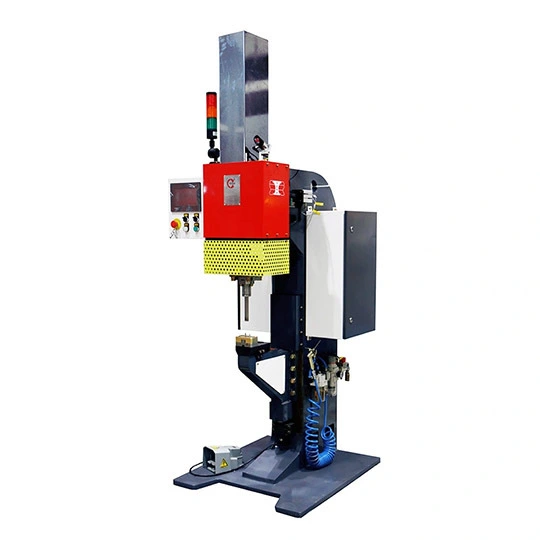
Introduction: The Rise of Self-Pierce Riveting in Industrial Assembly
In modern manufacturing, the demand for lightweight structures, multi-material integration, and high-strength joints has pushed engineers to move beyond traditional welding and fastening methods. One of the most effective solutions leading this transformation is self-pierce riveting (SPR).
Self-pierce riveting is a cold mechanical joining process that enables the fastening of two or more material layers without pre-drilled holes, without heat input, and with minimal surface damage. It is widely used in automotive body structures, aerospace assemblies, rail transport, and industrial equipment manufacturing where precision and reliability are critical.
Today, companies like Heron Welder are advancing SPR technology through automation-ready systems, integrated controls, and high-performance riveting equipment designed for high-volume production environments.
What Is Self-Pierce Riveting?
Self-pierce riveting (SPR) is a solid-state joining method in which a semi-tubular rivet is forced through the upper sheet material(s) and mechanically flared into the bottom layer using a die. This creates a permanent mechanical interlock without penetrating the final layer.
Unlike conventional riveting:
- No pre-punched holes are required
- No welding heat is involved
- No filler materials or adhesives are necessary (though sometimes combined for hybrid joints)
The result is a strong, fatigue-resistant joint suitable for modern lightweight structures made from aluminum, high-strength steel, and composites.
How the Self-Pierce Riveting Process Works
The SPR process is typically completed in four controlled stages:
1. Clamping Stage
The material stack is securely clamped between a punch and a die. Proper clamping ensures material stability and controls flow during deformation.
2. Piercing Stage
A high-strength rivet is driven into the top sheet. The rivet pierces through the upper layer(s) without fully penetrating the bottom sheet.
3. Flaring Stage
As the rivet reaches the die, it begins to radially expand (flare) inside the bottom layer, forming a mechanical lock.
4. Interlock Formation
The final joint is created when the rivet tail is securely embedded, producing a high-strength interlocked structure without bottom sheet breakage.
This cold-forming mechanism ensures structural integrity while avoiding heat distortion and metallurgical changes.
Key Advantages of Self-Pierce Riveting
SPR has become a preferred joining technology in high-performance manufacturing due to its unique benefits:
1. Ideal for Multi-Material Structures
SPR can join:
- Aluminum to steel
- Steel to composites
- Mixed lightweight alloys
This is essential for modern automotive and aerospace design where hybrid materials are standard.
2. No Heat-Affected Zone (HAZ)
Unlike welding, SPR does not involve melting. This eliminates:
- Thermal distortion
- Microstructural weakening
- Coating damage
3. High Static and Fatigue Strength
SPR joints provide excellent load-bearing capacity and long-term durability, especially under vibration and cyclic loading conditions.
4. Clean and Environmentally Friendly Process
- No fumes or sparks
- No welding gases
- Lower energy consumption
5. Automation-Friendly Technology
SPR integrates easily into:
- Robotic assembly lines
- CNC-controlled production systems
- Smart manufacturing cells
Self-Pierce Riveting vs Other Joining Methods
Manufacturers often compare SPR with welding and mechanical clinching. Each method has its strengths, but SPR stands out in multi-material applications.
SPR vs Resistance Spot Welding
- SPR: No heat, works on dissimilar materials
- Welding: Heat-dependent, limited material compatibility
SPR vs Clinching
- SPR: Higher joint strength due to rivet interlock
- Clinching: Lower cost but weaker mechanical locking
SPR vs Traditional Riveting
- SPR: No pre-drilling required, faster cycle time
- Traditional riveting: More steps, slower production
Industrial Applications of Self-Pierce Riveting
Automotive Manufacturing
SPR is widely used in:
- Body-in-white structures
- EV battery enclosures
- Door panels and chassis components
It plays a critical role in reducing vehicle weight while maintaining crash safety standards.
Aerospace and Rail Industry
SPR is used for:
- Lightweight fuselage panels
- Interior structural assemblies
- High-strength vibration-resistant joints
Industrial Equipment & Appliances
Used in:
- Machine housings
- HVAC systems
- Electrical enclosures
Process Optimization & Best Practices
To achieve consistent SPR joint quality, engineers must carefully control:
1. Material Stack Design
- Ensure correct hardness gradient
- Avoid brittle lower sheets
- Maintain proper thickness ratios
2. Rivet and Die Selection
- Rivet geometry must match material strength
- Die profile controls flaring behavior
3. Force and Stroke Control
Precise control of:
- Press force
- Penetration depth
- Riveting speed
4. Quality Inspection
Modern SPR systems use:
- Force-displacement monitoring
- Machine vision inspection
- Non-destructive testing methods
Role of Automation in SPR Systems
The future of self-pierce riveting is strongly tied to industrial automation and smart manufacturing. Robotic SPR systems ensure:
- High repeatability
- Reduced human error
- Faster cycle times
- Real-time quality monitoring
Advanced manufacturers like Heron Welder are developing integrated SPR solutions that combine:
- Servo-controlled riveting heads
- Intelligent controllers
- Automated feeding systems
- Data-driven quality assurance
These innovations allow OEMs to scale production while maintaining consistent joint reliability.
Why Manufacturers Choose Self-Pierce Riveting
For engineering teams and production managers, SPR offers a strategic advantage:
- Enables lightweight vehicle design
- Supports multi-material innovation
- Reduces production complexity
- Improves long-term durability
- Integrates easily into automation lines
As industries shift toward electric mobility and sustainable manufacturing, SPR continues to replace traditional joining techniques in many high-performance applications.
FAQs About Self-Pierce Riveting
1. What materials can be joined using self-pierce riveting?
SPR is commonly used for aluminum, steel, and hybrid combinations including coated and high-strength alloys.
2. Is self-pierce riveting stronger than welding?
In many multi-material applications, SPR provides better fatigue resistance and more consistent joint quality than spot welding.
3. Does SPR require pre-drilled holes?
No, SPR is a hole-less joining process that eliminates the need for pre-drilling.
4. Can SPR be automated in production lines?
Yes, SPR is widely used in robotic and automated assembly systems for high-volume manufacturing.
5. What industries benefit most from SPR?
Automotive, aerospace, rail transport, and industrial equipment manufacturing benefit the most from SPR technology.
Conclusion: The Future of High-Performance Mechanical Joining
Self-pierce riveting has become a cornerstone of modern manufacturing due to its ability to deliver strong, clean, and efficient joints across advanced material combinations. As industries continue to move toward lightweight design and automation, SPR will play an even more critical role in next-generation production systems.
With deep expertise in resistance welding and advanced joining technologies, Heron Welder provides industrial-grade SPR solutions tailored for OEMs, automation integrators, and large-scale manufacturers.
Request a Custom Solution from Heron Welder
Looking to upgrade your production line with advanced self-pierce riveting systems?
Contact Heron Welder today to explore customized SPR machines, automation integration, and high-efficiency welding solutions designed for your manufacturing needs.
 English
 Arabic
 French
 Spanish
 Portuguese
 Deutsch
 Turkish
 Dutch
Dutch
 Italiano
 Russian
 Romaian
 Portuguese (Brazil)
 Greek
Greek