English
 Arabic
 French
 Spanish
 Portuguese
 Deutsch
 Turkish
 Dutch
Dutch
 Italiano
 Russian
 Romaian
 Portuguese (Brazil)
 Greek
Greek

The Lincoln Lawyer Season 4: Premiere Date & Details
Games |
2025-12-13 02:07:53
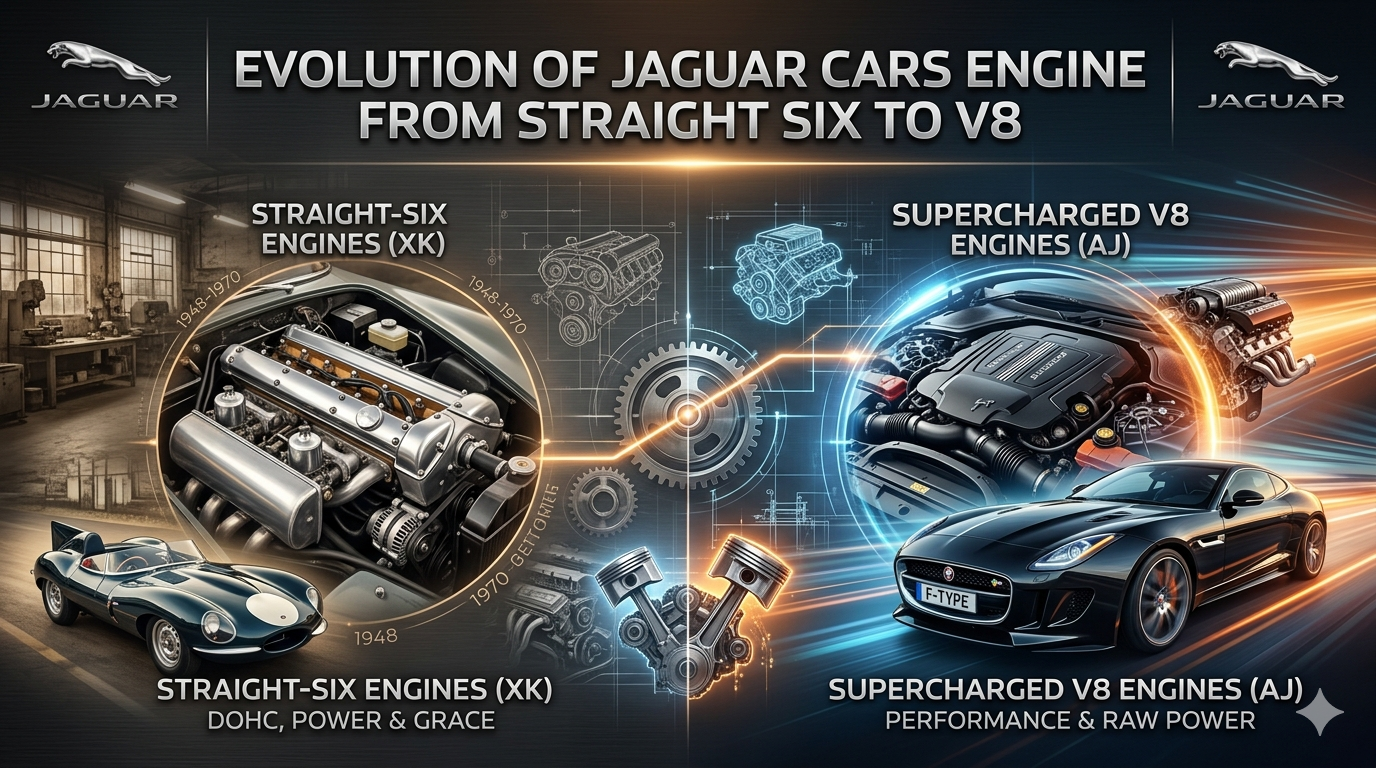
Few marques in automotive history have crafted a powertrain narrative as rich and emotionally resonant as Jaguar. From the pre-war drawing boards of Sir William Lyons to the modern aluminium architectures rolling out of Coventry, the Jaguar Cars Engine has always been something more than a mechanical assembly it has been the beating heart of a philosophy. That philosophy demands grace, pace, and space in equal measure, and the engines that powered each successive generation of Jaguars were engineered to deliver exactly that trinity.
To trace the evolution of Jaguar's powertrains is to trace the arc of British automotive ambition itself. It is a story that begins with a beautifully simple inline configuration, matures through decades of refinement and motorsport glory, and arrives inevitably at the thunder of a naturally aspirated and then supercharged V8. Along the way, the engineers at Jaguar made choices that were sometimes conservative, sometimes radical, always deliberate.
The architecture that defined Jaguar for the better part of five decades was the inline six-cylinder engine, an arrangement revered by engineers for its inherent mechanical balance. With three pairs of pistons perfectly counteracting each other's reciprocating forces, the straight-six produces a smoothness that four-cylinder and V6 configurations can only approximate.
The story properly begins in 1948 with the XK engine — a twin-overhead-camshaft, 3.4-litre straight six that was, by any measure, years ahead of its time. Designed during World War II by William Heynes, Walter Hassan, and Claude Baily, the XK unit debuted in the XK120 sports car and immediately announced itself as one of the finest road-going engines in the world. Producing 160 brake horsepower from a cast-iron block and aluminium cylinder head, it delivered the XK120 to a then-extraordinary 120 mph, making it the fastest production car on the planet at its launch.
The jaguar straight six engine went on to power some of the most iconic cars ever produced. The C-Type and D-Type race cars that dominated Le Mans in 1951, 1953, 1955, 1956, and 1957 all ran variations of this engine. On the road, it found its perfect partner in the E-Type, introduced in 1961 — a car that Enzo Ferrari himself reportedly described as the most beautiful ever made. The 3.8-litre XK in that car produced 265 bhp and pulled the E-Type to 150 mph, numbers that challenged Ferraris costing several times as much.
What made the jaguar straight six engine so enduring was its capacity for growth. Over the course of its production life, which stretched from 1948 all the way to 1992, the XK unit grew from 3.4 litres to 4.2 litres, gained fuel injection, electronic management systems, and progressively more sophisticated carburetion. It powered the XJ6 saloon, the XJ-S grand tourer, and generations of executive and sports cars that formed the core of Jaguar's commercial success.
By the late 1970s, even the most elegant engineering has its limits. The XK engine, magnificent as it was, had roots in wartime metallurgy and pre-computer design methodology. Jaguar knew that a new chapter was needed, and the result was the AJ6 — Advanced Jaguar Six — introduced in 1983 in the XJ-S and XJ6. This was a thoroughly modern engine: all-aluminium construction, 24 valves, and a taller, more compact architecture that allowed better packaging in increasingly complex engine bays.
The AJ6 family expanded over time into the AJ16 designation, incorporating electronic fuel injection as standard, variable valve timing in its later iterations, and outputs that climbed from a modest 165 bhp in 2.9-litre form to a very respectable 241 bhp in the 4.0-litre naturally aspirated version. A supercharged variant pushed that figure toward 320 bhp, hinting at the forced-induction future Jaguar was already planning.
Throughout the 1980s and early 1990s, these engines gave Jaguar the refinement and modernity needed to compete with BMW's six-cylinder range. The jaguar straight six engine lineage, now in its modern AJ guise, remained the character-defining choice for the brand even as Ford's acquisition in 1989 opened up new engineering possibilities.
The transition to V8 power was both commercially driven and technically inevitable. As Jaguar's competitors — Mercedes-Benz, BMW, Lexus — moved to eight-cylinder engines as the standard for full-size luxury saloons, Jaguar could not afford to remain a six-cylinder outlier in the premium marketplace. The answer arrived in 1997 in the form of the AJ-V8, a 4.0-litre, 32-valve all-aluminium V8 developed with Ford resources but engineered distinctly as a Jaguar Cars Engine.
Introduced first in the XJ8 and XK8, the jaguar v8 engines were immediately praised for their exceptional refinement. The 90-degree V8 configuration, combined with cross-plane crankshaft design and four-valve-per-cylinder heads, produced a broad, effortless power delivery that suited Jaguar's grand touring character perfectly. In naturally aspirated 4.0-litre form it produced 290 bhp; the supercharged XJR and XKR variants extracted 370 bhp, later rising to 400 bhp as management software and ancillary systems improved.
The arrival of Tata Motors as Jaguar's owner in 2008 coincided with a significant reinvestment in powertrain development. The 4.2-litre V8 was replaced by an all-new 5.0-litre unit in 2009, representing the most sophisticated Jaguar Cars Engine yet produced. The architecture used a spray-guided direct injection system that allowed far superior combustion efficiency compared to port injection.
The jaguar v8 engines in supercharged form progressively escalated through 470 bhp, 510 bhp, and eventually 550 bhp in the XKR-S and later F-Type R. The SVR variant of the F-Type pushed that to 575 bhp, with the Project 8 saloon — the most extreme road-going Jaguar ever built — extracting an extraordinary 600 bhp from the same fundamental architecture. That a road car designed to lap the Nürburgring in under eight minutes could share its engine block with a luxury saloon speaks to the remarkable breadth of the 5.0-litre V8's engineering.
The XF, Jaguar's executive saloon, offers perhaps the clearest lens through which to study the breadth of the brand's engine strategy. When the first-generation XF launched in 2008, the jaguar xf engine range spanned a turbodiesel straight-six, a naturally aspirated V8, and a supercharged V8 — three fundamentally different engineering approaches united by a single bodyshell. That range illustrated how Jaguar had matured from a manufacturer with a single signature powertrain to one capable of deploying entirely different engine philosophies for different customer segments.
The second-generation XF, introduced in 2015 and built on the lightweight aluminium architecture that underpins the modern Jaguar family, brought further sophistication. The jaguar xf engine lineup in this generation centred on the Ingenium family — modular four-cylinder petrol and diesel units developed entirely under Tata ownership as a clean-sheet design. These engines, built in a purpose-made facility in Wolverhampton, offered strong efficiency and competitive outputs while reducing the XF's kerb weight significantly compared to iron-block predecessors.
In the context of the XF range, the V8 option carried with it a statement of intent: this was a car for those who wanted the full Jaguar experience, defined not by efficiency targets but by effortless velocity. The jaguar xf engine options across both generations of the car represent a microcosm of everything Jaguar's engineers achieved in the transition from the six-cylinder age to the V8 era and beyond.
In what many regarded as a satisfying historical symmetry, Jaguar returned to the straight-six configuration in 2020 with the Ingenium P300 and P400 inline-six units — this time supplemented by a 48-volt mild-hybrid system. Displacing three litres and using a single twin-scroll turbocharger in conjunction with an electric supercharger, the P400 produced 400 bhp with a smoothness and linearity that recalled the finest qualities of the original XK. The wheel, in a very real engineering sense, had come full circle.
As Jaguar charts its transformation into a fully electric luxury brand, the combustion engine chapter is entering its final, remarkable pages. The engineers who designed the original XK unit in wartime secrecy could hardly have imagined that their work would span eight decades, power Le Mans champions, and end in a 400-horsepower mild-hybrid straight-six before giving way to electric motors entirely. Yet that is precisely the arc that the Jaguar Cars Engine has followed: from craft to competition to complexity, always in pursuit of the same ideal — that a Jaguar should move you, in every sense of the word.
The journey of the Jaguar Cars Engine from the twin-cam XK straight-six of 1948 through the supercharged 5.0-litre jaguar v8 engines of the modern era is one of the great continuous narratives in automotive engineering. It is a story of refinement rather than revolution, of each generation of engineers taking what worked, discarding what didn't, and pushing further toward an ideal of effortless, characterful performance.
Understanding these engines their specifications, their quirks, their service requirements, and their failure modes is essential for any owner who wants to keep a Jaguar in the condition it deserves. Whether you drive a classic XK-powered E-Type, an AJ-V8 XK8, or a modern supercharged F-Type, quality parts sourced from a knowledgeable supplier make all the difference. Moon Auto Parts offers a trusted range of Jaguar engine components, ensuring that the legacy of these remarkable powertrains continues on the road for decades to come.
From the serene hum of an inline six at motorway speed to the supercharged howl of a V8 at full throttle, Jaguar has always known that the engine is not merely a means of propulsion it is the soul of the car.