English
 Arabic
 French
 Spanish
 Portuguese
 Deutsch
 Turkish
 Dutch
Dutch
 Italiano
 Russian
 Romaian
 Portuguese (Brazil)
 Greek
Greek

Indian Escorts in Dubai – Discreet, Elegant & Premium Companionship
Home |
2025-12-22 07:47:38
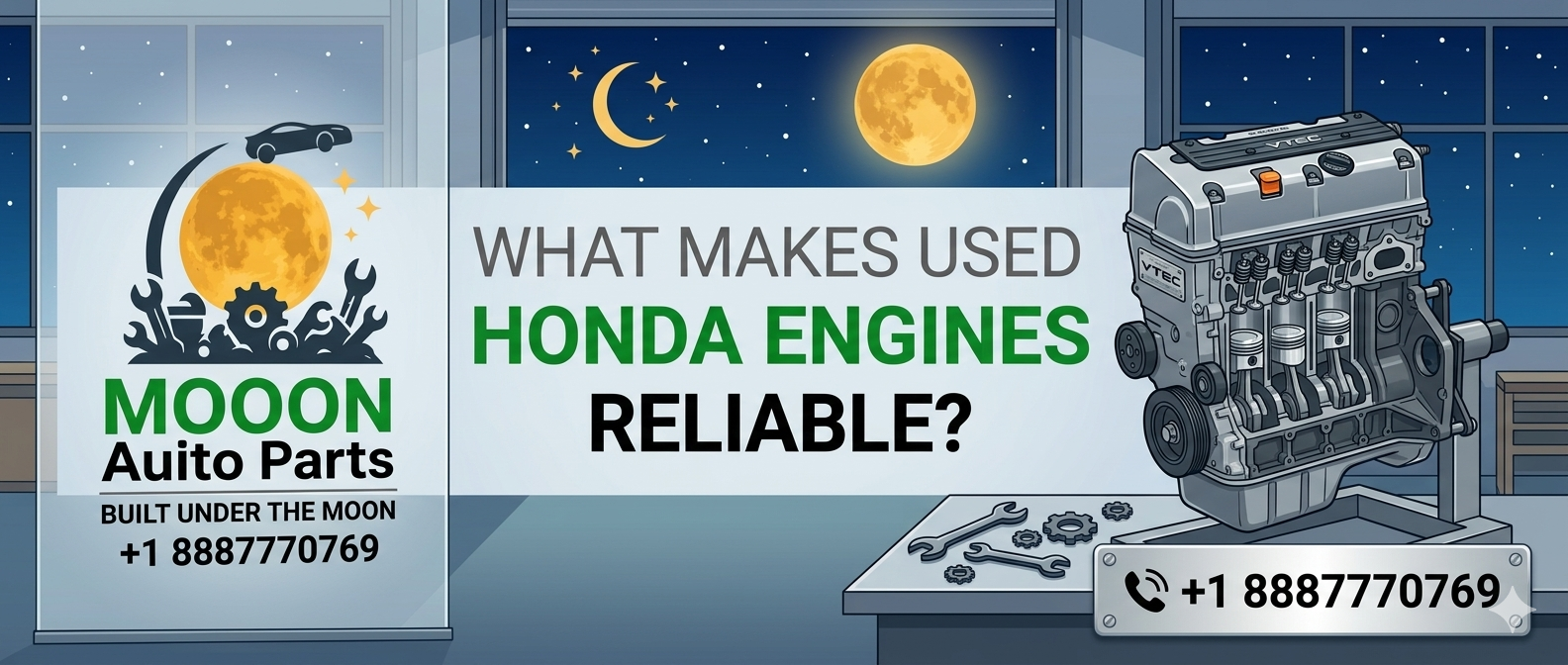
Honda has earned a global reputation for engineering engines that simply refuse to quit. From the compact city streets of Tokyo to the sun-baked highways of California, Honda-powered vehicles continue running long after other brands have given up. But what exactly is it that makes used Honda engines so sought after, so trusted, and so consistently reliable? The answer lies in a combination of precision engineering, intelligent design philosophy, and decades of refinement.
This blog takes an analytical look at the mechanical and engineering qualities that make used Honda engines a smart investment, which models dominate the used market, what types of used Honda transmissions are available, and what buyers should examine before committing to a purchase.
Honda's engineering culture emphasizes what the company calls 'man maximum, machine minimum' — the idea that vehicles should serve their owners efficiently and reliably rather than demanding constant attention. This philosophy manifests in the engine bay through tight tolerances, high-quality metallurgy, and a preference for naturally aspirated designs that place less thermal and mechanical stress on internal components.
Honda engines also benefit from VTEC (Variable Valve Timing and Lift Electronic Control) technology, which optimizes valve operation across different RPM ranges. This not only improves fuel efficiency and performance but also reduces internal wear — meaning Honda engines sustain less damage over time at both high and low loads compared to conventional single-cam designs.
Understanding Honda's engine families is critical when evaluating a used unit. Honda organizes its engines into clear lineages, each with well-documented characteristics:
✔ Honda Civic (1.5L L15B7 turbo, 1.5L L15A VTEC, 2.0L K20C1 Type R) — one of the most abundant used engine sources in the USA
✔ Honda Accord (2.0L K20C2 turbo, 1.5L L15B7, 2.4L K24Z3, 3.5L J35Y) — broad engine range spanning four-cylinder and V6 platforms
✔ Honda CR-V (1.5L L15B7 turbo, 2.4L K24Z1/K24W) — popular SUV with a well-regarded naturally aspirated history
✔ Honda Pilot (3.5L J35Y8 V6, 3.5L J35Z4) — three-row SUV with Honda's proven J-series V6
✔ Honda HR-V (1.8L R18A, 1.5L L15B) — fuel-efficient subcompact with a reliable low-displacement engine
✔ Honda Odyssey (3.5L J35Y, 3.5L J35A) — full-size minivan powered by the renowned J35 V6
✔ Honda Ridgeline (3.5L J35Y6) — unibody truck sharing the J-series platform
✔ Honda Fit (1.5L L15A, 1.5L L15Z1) — subcompact with an impressively efficient small engine
✔ Honda Passport (3.5L J35Y5) — mid-size SUV with the J-series V6
✔ Honda Element (2.4L K24A4) — boxy crossover with a dependable K-series four-cylinder
Two engine families dominate the used Honda engine market and for good reason:
The K-Series (K20 and K24):
Introduced in 2001, the K-series quickly became one of the most celebrated engine families in automotive history. The K20 (2.0L) and K24 (2.4L) share an all-aluminum block and head, a chain-driven DOHC valvetrain, and Honda's i-VTEC system. These engines are known for their excellent power-to-weight ratio, smooth rev characteristics, and a remarkable ability to accumulate mileage without requiring major internal work. K24-powered CR-Vs and Accords routinely reach 200,000 miles on the original engine.
The J-Series (J35 and J30):
Honda's V6 engine family for larger vehicles, the J-series is equally well-regarded. The J35 3.5L, found in Pilots, Odysseys, Accord V6s, and Ridgelines, delivers strong torque with the reliability Honda is famous for. Its VCM (Variable Cylinder Management) system can occasionally present maintenance considerations in high-mileage units, but the fundamental engine architecture is robust and proven.
Several specific design and manufacturing qualities contribute to Honda engine longevity that buyers should understand:
✔ Aluminum block and head construction — reduces weight and improves heat dissipation compared to iron blocks
✔ Chain-driven camshafts (K-series, J-series) — chains last significantly longer than rubber timing belts and do not require scheduled replacement at fixed intervals
✔ Hydraulic valve adjustment — eliminates the need for periodic manual valve clearance adjustment on many Honda engines
✔ Forged steel crankshaft in performance variants — provides greater resistance to fatigue and stress fractures
✔ Honda's stringent factory tolerances — internal clearances are tighter than many competitors, reducing oil consumption and blow-by over time
✔ Conservative power output in naturally aspirated units — Honda's NA engines are typically undertuned relative to their displacement, reducing long-term stress
Used transmission lineup reflects the same commitment to reliability as its engines. Understanding Used transmission for sale the options helps buyers complete a successful powertrain swap:
✔ K20/K24 5-speed manual (EM2, EP3) — lightweight, precise, and one of the most beloved manual gearboxes in the compact car segment
✔ 6-speed manual (FA5, FG2, FN2) — found in Civic Si and Accord Sport models; highly sought after in the used market
✔ 5-speed automatic (BAXA, MAXA, SLXA) — used across first and second-generation CR-Vs and Civics; simple torque-converter design with a long track record
✔ 6-speed automatic (ZF-sourced) — found in Accord V6 and Pilot; smooth and durable when properly maintained
✔ CVT (Earth Dreams) — introduced in Civic and HR-V; reliable when CVT fluid is changed every 30,000 to 40,000 miles
✔ 9-speed DCT (ZF9HP) — used in the CR-V and Pilot; advanced but requires careful inspection when buying used
Avoid used Honda CVT units that cannot provide a fluid history. Degraded fluid is the leading cause of CVT failure in Honda applications, and a unit without documentation carries meaningful risk.
Even Honda's legendary reliability does not make due diligence unnecessary. Conduct or request these checks before finalizing any used engine purchase:
✔ Verify the engine code — K20A2, K24A4, J35Y, L15B7, and so on — to confirm compatibility
✔ Request a compression test: 175 to 185 PSI is typical for a healthy K-series cylinder; anything below 160 PSI warrants concern
✔ Inspect the VTEC spool valve solenoid for oil fouling or blockage — a common issue on high-mileage units
✔ Check for excessive oil consumption by inspecting the spark plugs for oil contamination
✔ On J-series V6 engines, inspect the VCM system and ask whether the Active Noise Cancellation (ANC) system is intact
✔ Verify timing chain wear — rattle at startup on K-series engines can indicate a stretched chain
✔ Confirm the oil pan and mating surfaces are free from cracks or stripped bolt threads
Used Honda engines earn their reputation through a combination of deliberate engineering choices, conservative tuning, advanced valve technology, and premium materials. Whether you are replacing the 2.4L K24 in a beloved CR-V, sourcing a 3.5L J35 for an Odyssey or Pilot, or hunting down a K20 for a Civic performance build, the used engine market offers quality at a fraction of new-part pricing. Moon Auto Parts maintains a curated inventory of used Honda engines and transmissions spanning all major model families, providing buyers with tested, mileage-verified units backed by warranty coverage.
1. How many miles can a used Honda K24 engine last after installation?
A K24 engine sourced from a donor vehicle with under 80,000 miles can reasonably last another 100,000 to 150,000 miles or more with proper maintenance. Regular oil changes every 5,000 miles using the correct Honda-specified oil grade are the single most important factor in longevity.
2. Is the Honda 1.5L turbocharged L15B7 engine reliable when bought used?
The L15B7 is generally reliable but had early oil dilution concerns in cold climates, particularly in 2017 to 2018 CR-V models. Post-2019 units benefited from revised ECU mapping that addressed the issue. When buying a used L15B7, confirm the software has been updated and inspect the oil for any fuel smell.
3. What is the most reliable used Honda V6 engine to buy?
The J35Y series is widely considered the most refined iteration of Honda's V6 lineup. Post-2014 J35Y units from Pilots and Odysseys are excellent choices. If purchasing an Accord V6 unit, confirm that VCM system components are intact and functioning.
4. Are Honda CVT transmissions worth buying used?
They can be, provided a complete CVT fluid service history is available. A properly maintained Honda CVT can last well beyond 150,000 miles. Without documented fluid changes, however, the risk of internal wear is significantly elevated.
5. Can a Honda K20 engine fit in a Civic that originally had a D-series engine?
Yes, but it is a significant modification. Engine mounts, transmission, axles, fuel system, and ECU all need to be adapted. Numerous swap kits exist that streamline the process, but it remains a project for experienced builders and requires professional calibration of the engine management system.
Learn More - Why Choose a Used Suzuki Engine?