English
 Arabic
 French
 Spanish
 Portuguese
 Deutsch
 Turkish
 Dutch
Dutch
 Italiano
 Russian
 Romaian
 Portuguese (Brazil)
 Greek
Greek

Yellow Peel in Dubai with Vitamin C Serum – A Power Combo
Health |
2026-04-25 07:17:23
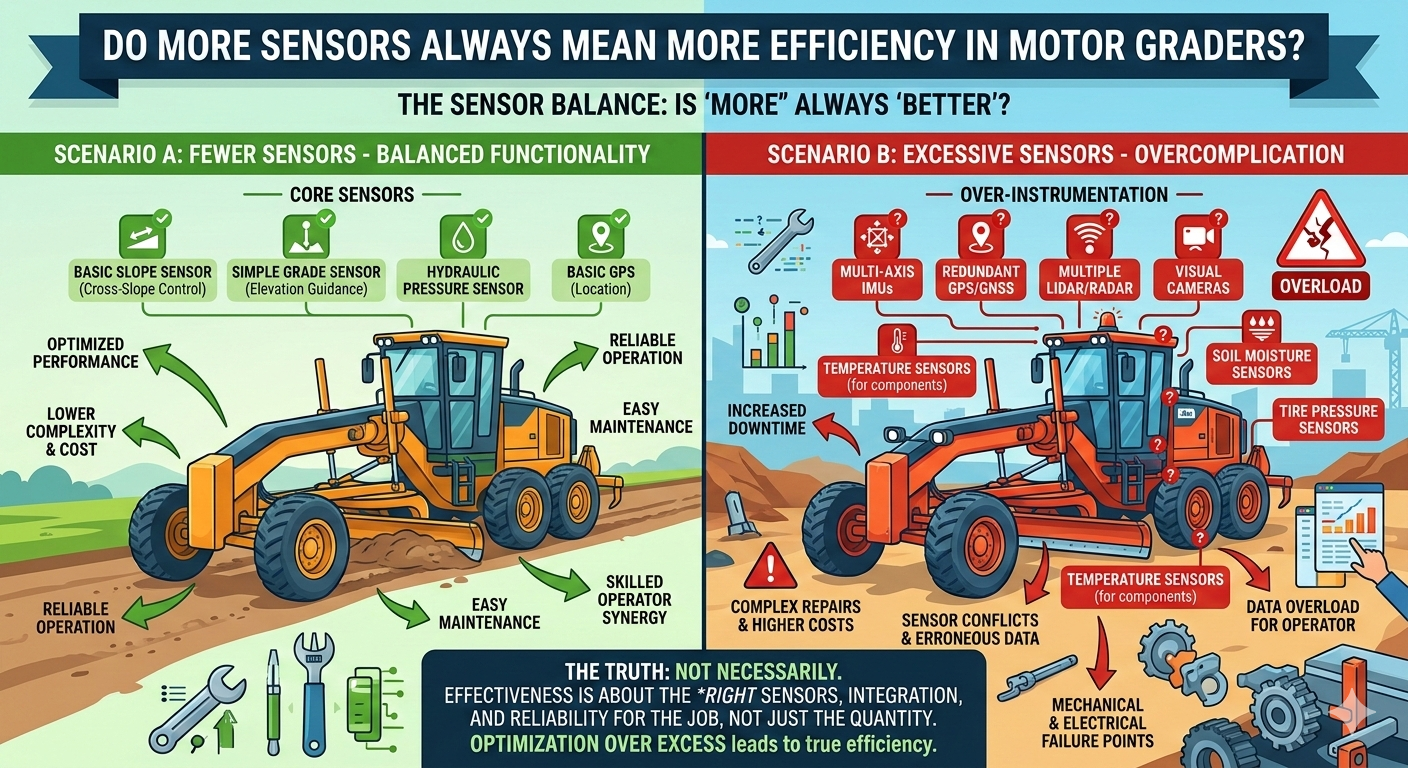
The current construction equipment is full of sensors, and motor graders are not an exception. GPS modules, cameras, and telematics systems are just a few of the technological advancements that modern machines are full of, aimed at enhancing performance. However, does the addition of more sensors necessarily imply increased efficiency? The answer to this question is: not necessarily. Although sensors can enhance the grading accuracy, safety, and maintenance, the increased number of them does not necessarily lead to improved results. The important thing is the selection, integration, and application of the sensors in the field, whether operating a new or a used motor grader.
We can examine the sensors typically fitted on modern graders before judging their actual impact. These sensors collect information about the machine’s environment and internal mechanisms, then transfer that data to onboard computers that help operators make decisions or allow systems to operate independently.
Examples of common sensor systems are:
GPS and GNSS modules: Real-time blade positioning, which guarantees accurate grading.
Inertial Measurement Units (IMUs): Combined with GNSS to track chassis and blade orientation.
Ultrasonic and radar sensors: Close-range object detection and safety.
Onboard health monitoring: Telematics that monitor engine performance and component wear.
Cylinder position and slope sensors: Working with Electro-Hydraulic (E-H) valves to provide precise cut depth control.
These technologies are effective tools, and their worth is determined by the extent to which they will be integrated into the control systems of a used motor grader and the workflow of the operator.
The benefits are real when sensors are sensibly applied. Supervisors and operators both report that it is now possible to grade jobs previously requiring more hours to do in less time with fewer passes and less guesswork.
The following are some of the beneficial effects that sensors that are well integrated provide:
Improved accuracy of grading using GPS-guided machine control systems.
Less time spent in work cycles, less time spent on the same area, and thus less fuel consumption.
Live telematics information that can be used to perform proactive maintenance before failures.
Greater safety on the job site due to the obstacle detection and automatic alerts.
Fleet data analytics to enhance planning and workflow.
Practical applications validate the theoretical efficiency of these systems. Contractors who use sensor-intensive graders tend to point to quantifiable improvements in production efficiency and error reduction.
One earth-moving company reported that the use of GPS and blade sensors on their graders saved up to 50 percent of rework done by machines that lacked sophisticated positioning systems. Vision systems assisted operators in maintaining a steady blade grade on challenging terrains with changing ground conditions where manual control would have been difficult.
Telematics data provided by sensor networks is also valued by fleet managers since it enables them to identify trends such as increased coolant temperatures or premature tire wear, before they lead to expensive repairs. However, despite these victories, it is not all about the number of sensors one may have. An excessive number of data points that are not put into practice may overload operators and slow down decision-making.
Although it could be beneficial, the solution is not to add more sensors. Actually, several difficulties can compromise the value they are offering:
Acquisition costs may be too high for small or low-budget-oriented contractors.
Retrofitting sensors to older systems can require custom fabrication and extensive software integration.
Environmental factors like dust, mud, or extreme weather may require sensors to be cleaned and calibrated frequently.
Data overload, where operators get used to warnings (alert fatigue) or may not be able to interpret information.
Training requirements for operators and technicians to utilize sensor insights to the fullest.
The comparison of sensor-enriched motor graders with more conventional ones brings out the points where technology is appropriate and where simplicity remains a valuable asset.
|
Feature |
Sensor-Rich Graders |
Traditional Models |
|
Accuracy |
High (Centimeter-level) |
Manual/Operator Dependent |
|
Complexity |
High (Electronic/Software) |
Low (Mechanical/Hydraulic) |
|
Capital Cost |
Higher Initial Investment |
Lower Initial Investment |
|
Maintenance |
Specialized (Digital Tools) |
Standard (Mechanical Tools) |
|
Best Use |
Large Infrastructure/High Precision |
General Maintenance/Small Pads |
Economic and Productivity Considerations
The other aspect of this debate is the economic aspect. Graders with sensors are capable of shortening the time and enhancing consistency, although the value proposition varies with the scale and type of work being performed.
The saving of time and less rework can easily pay back the investment in large grading contracts. Reduced machine passes will result in reduced fuel consumption and reduced wear on important parts such as tires and blades. But in smaller jobs, the payback period can be much longer. Data indicates that sensor benefits increase with fleet size; fleet-wide analytics can revolutionize maintenance culture and job forecasting.
Experts advise: To maximize sensor systems without being overwhelmed by volumes of data or expense, it is advisable to:
Target Needs: Consider sensors that directly influence the precision of grading and job demands.
Environmental Match: Find sensor systems that match your tasks and terrain environment.
Training: Educate operators and technicians on sensor interpretation.
Software Integration: Incorporate telematics in planning and maintenance software as much as possible.
ROI Assessment: Assess the payback of the investment prior to the inclusion of high-cost sensor systems.
There is no doubt that sensors can enhance the performance and efficiency of the contemporary motor graders, particularly when selected and implemented wisely. Nevertheless, the number of sensors does not necessarily translate into improved outcomes. Rather, the efficiency gains are the result of the right combination of sensor technology, combined with trained operators, and integrated systems. When considering the choices between a new and a used motor grader, look at the compatibility of sensor systems with your objectives and workflow, and not at the number of sensor systems.
A: Not always. Although sensors have the potential to improve accuracy and information, excess sensors without a clear purpose may complicate business processes and result in unnecessary expenses.
A: Manufacturers achieve the most direct gains in grading accuracy and machine health monitoring by integrating GPS/GNSS positioning, blade position sensors, and telematics modules.
A: Yes. Sensors are prone to interference by dust, mud, snow, and rain, and thus need frequent cleaning, calibration, or protection systems to ensure data integrity.
A: It’s highly recommended. Sensor data can be used by operators and technicians to enhance efficiency, minimize rework, and identify maintenance problems in their early stages.