English
 Arabic
 French
 Spanish
 Portuguese
 Deutsch
 Turkish
 Dutch
Dutch
 Italiano
 Russian
 Romaian
 Portuguese (Brazil)
 Greek
Greek

Hadoop-as-a-Service Market to Surpass USD 1,004.73 Billion by 2034, Driven by Rapid Enterprise Cloud Adoption
Other |
2026-05-04 06:57:41
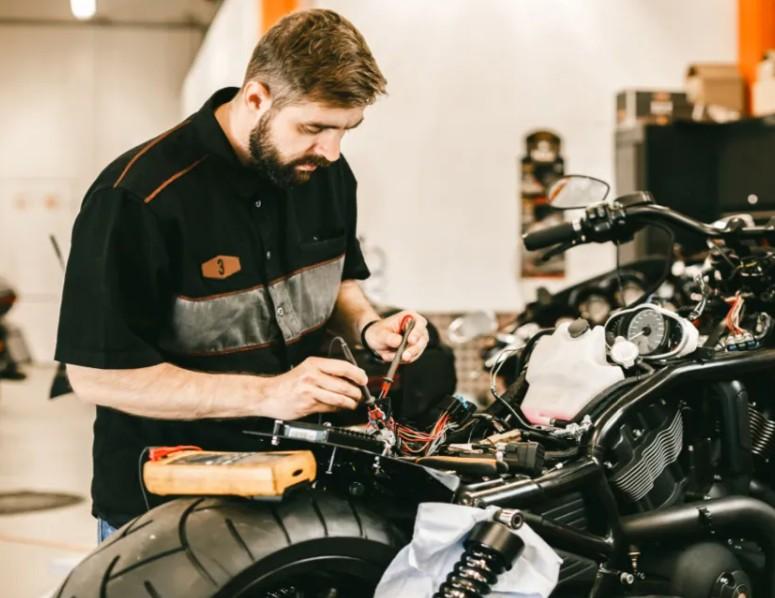
For any rider, few mechanical sensations are as jarring as the "false neutral." You are accelerating hard, leaning into a corner, or perhaps just cruising at highway speeds; you flick the gear lever upward to engage the final drive, only to hear the engine scream toward the redline as the transmission fails to find the next cog. While a true neutral exists only between first and second gear, a false neutral is an unintended "no-man's land" between any two higher gears where the dog clutches fail to engage. This phenomenon is particularly common between 5th and 6th gear on modern sequential gearboxes. Understanding the mechanical dance occurring inside your crankcase is vital for both safety and the longevity of your machine.
To understand a false neutral, one must first understand how a motorcycle gearbox actually functions. Unlike a car's manual transmission, which uses synchromesh rings, a motorcycle uses a "constant-mesh" system. In this setup, all gear pairs are always spinning and meshed together, but only one pair is "locked" to the output shaft at any given time. This locking is achieved by "dogs"—protruding tabs on the side of one gear that slot into corresponding "windows" or recesses on its neighbor. When you move the gear lever, you are rotating a shift drum. This drum has precisely machined tracks that move selector forks back and forth, sliding the gears into their locked positions.
A false neutral occurs when the selector fork moves the gear far enough to disengage from its current partner but fails to push it far enough to lock into the next one. The gears are left floating in a transitional space where no power can be transferred. In a professional motorbike maintenance course, students learn that the tolerances for these movements are measured in fractions of a millimeter. Between the high-speed ratios of 5th and 6th gear, the rotational speeds are at their peak, and the margin for error is at its thinnest.
The jump between the two highest gears is often the most susceptible to false neutrals for several reasons. Firstly, the physical distance the selector fork must travel is standardized across the shift drum, but the rotational inertia of the shafts is highest in the top gears. When you are traveling at high speeds, the speed differential between the shafts can make it harder for the dogs to "find" their windows. If the rider provides a "lazy" or incomplete flick of the toe, the drum may not rotate fully into the detent (the notch that holds it in place), leaving the transmission in limbo.
Furthermore, the higher gears are often at the far end of the transmission shafts, furthest away from the shift drum’s primary support. Any slight flex in the selector forks or wear in the shift drum tracks is amplified at these extremities.
The gearbox and the engine on most modern motorcycles share the same oil. This oil is not just a lubricant; it is a hydraulic medium and a cushion. If the oil is old, it loses its "shear stability," meaning the molecules break down under the intense pressure of the gear teeth. Thin, degraded oil fails to provide the necessary slickness for the selector forks to slide easily across the shafts. Conversely, oil that is too thick (wrong viscosity) can create "drag" that prevents the dogs from engaging cleanly.
Contaminants in the oil, such as microscopic metal shavings from normal wear, can also migrate into the shift drum tracks or onto the selector fork rods. This creates friction that the rider feels as a "notchy" gearbox. In a motorbike maintenance course, one of the first lessons is how to analyze spent oil for "glitter," which can indicate that the gear dogs are becoming rounded off. Once the edges of the dogs lose their sharp 90-degree profile, they tend to "reject" engagement, pushing themselves back into a false neutral under load.
While mechanical wear is a factor, many false neutrals are actually caused by improper ergonomics. The shift linkage—the series of rods and pivots connecting your foot lever to the gearbox—must be adjusted to suit the rider's boot size and ankle flexibility. If the lever is set too high, the rider may find it difficult to complete the full upward stroke required to rotate the shift drum into the 6th gear detent. This results in a "half-shift" that invariably ends in a loud, grinding false neutral.
Properly adjusting these linkages is a fundamental skill. A motorbike maintenance course teaches riders how to set up their controls so that the "throw" of the lever is optimized for their natural range of motion. Additionally, pivots and rose joints in the linkage can become dry or clogged with road grime, adding resistance to the shift. Keeping these points cleaned and lubricated with the correct grease can often solve 50% of gear-shifting issues without ever opening the engine cases.
Ignoring frequent false neutrals is a recipe for catastrophic engine failure. Every time the gearbox "slips" out of gear or fails to engage, the dogs are clashing against each other at high speeds. This rounds off the edges of the dogs and can eventually bend the selector forks. A bent selector fork will then rub against the spinning gear, creating immense heat and eventually turning the oil black with metal debris. In the worst-case scenario, the gearbox can "lock up," which is a terrifying prospect at the speeds usually associated with 5th and 6th gear.